Home › Blog › Social Chess Clubs in 2026: A Data Report
Social Chess Clubs in 2026: A Data Report
Social chess in 2026 is a weekly habit: most clubs we can measure meet every week, usually on a Tuesday or Wednesday evening starting at 18:00 or 19:00, often in a bar, and they announce it on Instagram. Most of the clubs we can date started in 2023 or later (141 of 205).
I build Checkmate IRL, and every figure here comes from its own data: the social chess clubs directory, the feed of casual chess events and the venue map, all queried on 23 October 2026. Those counts measure what we've catalogued, so each section ends with its main caveat, and the method section at the end covers the rest.
The numbers at a glance
| Finding | Figure |
|---|---|
| Social chess clubs listed | 253 in 33 countries and 115 cities |
| Clubs that started in 2023 or later | 141 of 205 we could date (68%), median year 2024 |
| Most common club nights | Tuesday and Wednesday, for 48% of clubs (a statistical tie) |
| Quietest night we see | Friday, 4% of clubs |
| Most common start | 18:00 or 19:00, for 62% of clubs |
| Busiest club slot of the week | Wednesday at 18:00, 17 clubs |
| Clubs that meet weekly | 61% of the clubs we can measure |
| Length of a chess night | About 3 hours, most often ending at 22:00 |
| Clubs that play in a bar at least sometimes | 43% of 170 clubs with a known venue |
| Clubs in a bar, UK against Germany | 54% (of 35) against 18% (of 22), p ≈ 0.012 |
| Clubs with no fixed home | 24% use 2 or more venues |
| Clubs on Instagram | 71%, and 47% use nothing else |
| Places to play on our map | 4,600+ in 100+ countries |
When did these clubs start?
Most of the clubs we can date started in 2023 or later: 141 of 205, and the median start year is 2024. A club's start year here is the year its earliest public page or account was created, the earliest one we could find, and we could date 205 of our 253 listed clubs (81%). 2024 is the biggest single year, with 43 clubs, while 2018 to 2020 together come to only 9.
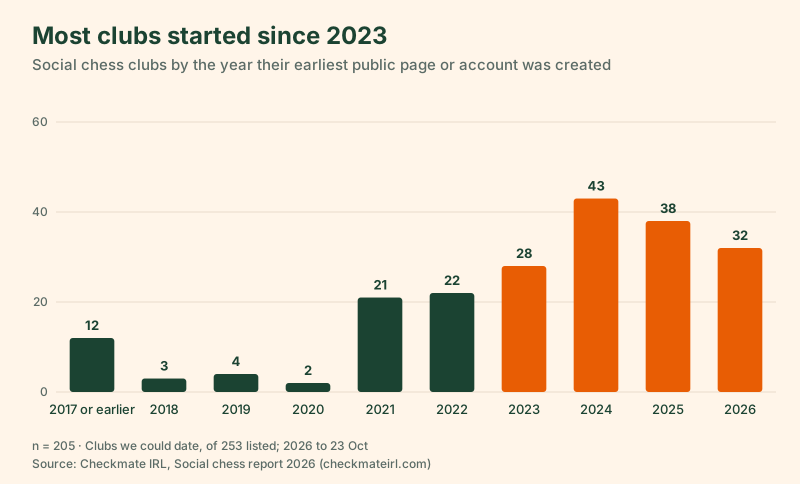
| Start year | Clubs |
|---|---|
| 2017 or earlier | 12 |
| 2018 | 3 |
| 2019 | 4 |
| 2020 | 2 |
| 2021 | 21 |
| 2022 | 22 |
| 2023 | 28 |
| 2024 | 43 |
| 2025 | 38 |
| 2026, to 23 October | 32 |
| All clubs dated | 205 |
The pattern shows up in each of the 3 biggest countries, though the groups get small:
| Country | Clubs dated | Started 2023 or later | 95% confidence interval |
|---|---|---|---|
| United States | 91 | 60 (65%) | 55 to 74% |
| United Kingdom | 32 | 27 (84%) | 68 to 93% |
| Germany | 20 | 15 (75%) | 53 to 88% |
The UK and German groups are small, so their ranges are wide.
Accounts get renamed, so we checked whether that skews the picture. 49 of the 170 accounts we checked were renamed at least once. Leaving out the 47 dated clubs whose date comes from a renamed account, the share since 2023 stays at 69% (109 of 158), so renaming doesn't drive the pattern.
Does this mean social chess is growing?
The dates fit a wave of new clubs since 2023. On their own, they can't prove growth, because we only see clubs that are still running and listed today. Clubs that started and stopped earlier are missing, which tilts the picture toward recent years, so a high share of young clubs also fits a scene where clubs come and go quickly. Our article on the rise of social chess clubs covers the trend and the people behind it.
What to keep in mind:
- A page date isn't a founding date. A club can be older than its online presence, so some clubs started earlier than shown here.
- Accounts change. They get renamed or repurposed, so a date can come from before an account belonged to the club.
- Survivorship. We only see clubs that are still running and listed today. Clubs that started and stopped earlier are missing, which tilts the picture toward recent years.
- Our directory grows. We add clubs as we find them, while these dates come from each club's own pages and accounts, so they're independent of when we added a club.
- 2026 is partial. It covers less than 10 months, up to 23 October.
How many social chess clubs are there, and where?
Our directory lists 253 social chess clubs in 33 countries and 115 cities, and London has the most. London lists 31 clubs, ahead of New York (21), Los Angeles (14), Chicago (12) and Berlin (10).
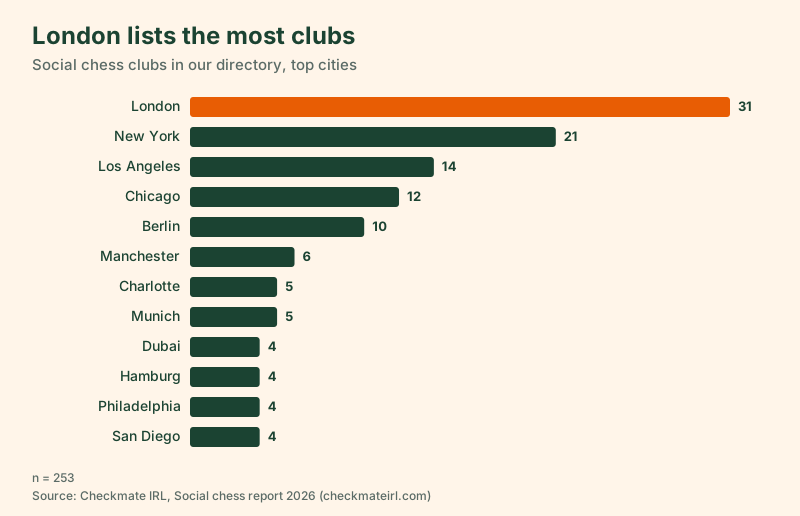
| City | Social clubs listed |
|---|---|
| London | 31 |
| New York | 21 |
| Los Angeles | 14 |
| Chicago | 12 |
| Berlin | 10 |
| Manchester | 6 |
| Charlotte | 5 |
| Munich | 5 |
| Dubai | 4 |
| Hamburg | 4 |
| Philadelphia | 4 |
| San Diego | 4 |
By country, 3 countries hold 72% of listed clubs:
- United States: 102 clubs
- United Kingdom: 49
- Germany: 32
- Poland: 5
- Australia, India, Italy, the Netherlands and the UAE: 4 each
- Canada, France, Japan, Portugal, Singapore and Spain: 3 each
Our city pages for London, New York and Berlin list the clubs alongside the other places to play there.
This lean toward English-speaking cities is partly our sourcing, which is strongest in English. We hold no population data, so there are no per-capita figures here.
Which night is chess night?
Tuesday and Wednesday, together. Of the 143 social chess clubs with events in our feed, 36 usually meet on a Wednesday and 33 on a Tuesday, a gap too small to call: statistically, the 2 nights are tied. Between them, they account for 69 of those 143 clubs, or 48%. Friday is the quietest night we see: only 7 clubs (4%) usually meet then, clearly fewer than on Tuesday or Wednesday.
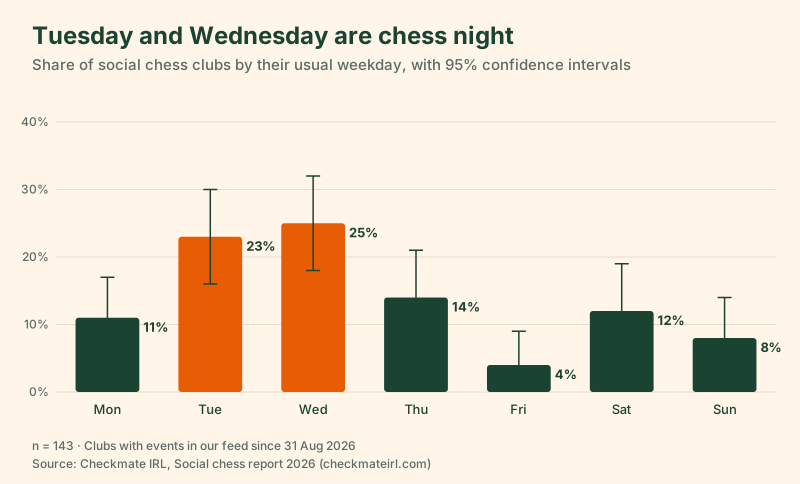
| Usual night | Clubs | Share of clubs | 95% confidence interval | Dated event listings |
|---|---|---|---|---|
| Monday | 16 | 11% | 7 to 17% | 191 |
| Tuesday | 33 | 23% | 16 to 30% | 202 |
| Wednesday | 36 | 25% | 18 to 32% | 218 |
| Thursday | 21 | 14% | 9 to 21% | 172 |
| Friday | 7 | 4% | 2 to 9% | 118 |
| Saturday | 18 | 12% | 8 to 19% | 177 |
| Sunday | 12 | 8% | 4 to 14% | 219 |
Each club counts once, on the weekday it meets most often. 24 of the 143 clubs meet on 2 or more different weekdays, so this is their main night. The confidence interval is the range a night's true share most likely sits in, given that we only see 143 clubs: Tuesday's and Wednesday's ranges overlap almost entirely, while Friday's sits well below both. Counted by single dated listings instead, Friday is lowest again (118 of 1,297, against about 185 if every day were equal), while Wednesday and Sunday sit level at the top. The weekly slots clubs state for themselves point the same way: 21 on a Wednesday, 15 on a Tuesday and 4 each on Friday and Saturday.
The data covers events from 31 August 2026 onward for 143 of our 253 listed clubs, and the feed leans English-speaking.
What time do chess clubs start?
At 18:00 or 19:00 local time, for most clubs. 89 of the 143 clubs with events (62%) usually start in one of those 2 hours, and 18:00 is the single most common start, with 48 clubs. Only 7 clubs usually start at 20:00 or later.
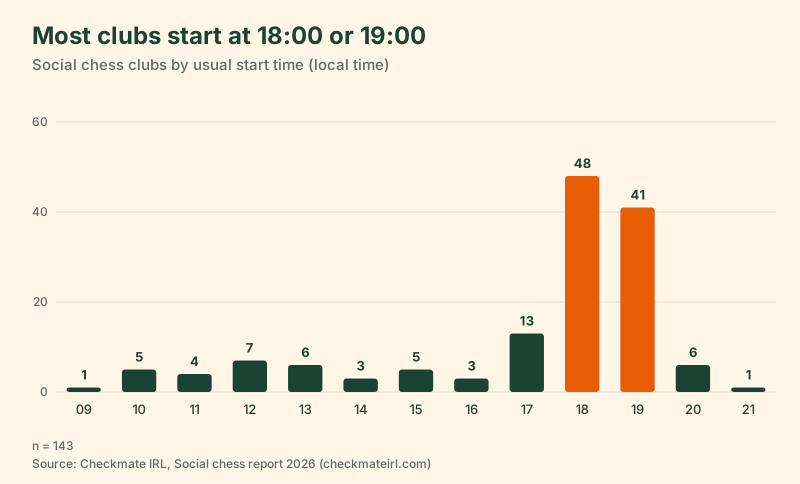
| Usual start | Clubs | Share of clubs |
|---|---|---|
| 09:00 to 16:00 | 34 | 23% |
| 17:00 | 13 | 9% |
| 18:00 | 48 | 33% |
| 19:00 | 41 | 28% |
| 20:00 or 21:00 | 7 | 4% |
Starts are grouped by the hour, so an 18:30 start counts as 18:00. The daytime clubs are mostly weekend clubs: 25 of the 34 that start before 17:00 meet on a Saturday or Sunday. Single listings tell the same story: the median dated event starts at 18:00, nearly 6 in 10 start between 18:00 and 19:59, and only 17 of 1,297 start at 20:00 or later. Across all club events, 69% fall on a weekday evening, Monday to Friday from 17:00.
These are start times as organisers list them, in local time.
When is the busiest hour of the week?
Wednesday at 18:00. 17 clubs usually meet in that slot, more than any other, followed by Tuesday at 19:00 (15 clubs) and Wednesday at 19:00 (13). On weekdays, 97 of the 113 clubs start between 17:00 and 19:00; at the weekend, starts spread across late morning and midday.
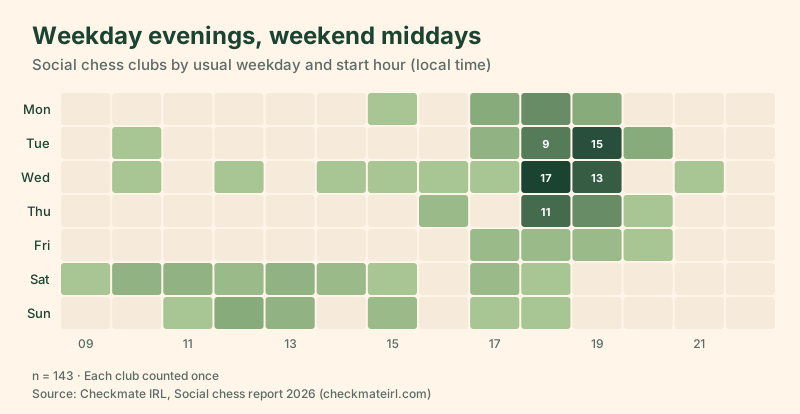
| Day | Clubs | Most common start | Clubs starting before 17:00 |
|---|---|---|---|
| Monday | 16 | 18:00 (7 clubs) | 1 |
| Tuesday | 32 | 19:00 (15 clubs) | 1 |
| Wednesday | 37 | 18:00 (17 clubs) | 5 |
| Thursday | 21 | 18:00 (11 clubs) | 2 |
| Friday | 7 | 17:00, 18:00 and 19:00 (2 each) | 0 |
| Saturday | 18 | 10:00, 11:00 and 13:00 (3 each) | 15 |
| Sunday | 12 | 12:00 (4 clubs) | 10 |
Here each club sits in its single most common weekday-and-hour slot, which moves 1 club from Tuesday to Wednesday compared with the weekday table above.
Counting events instead of clubs gives the same top slot: Wednesday at 18:00 has the most events of any hour in the week. Counted by how many different organisers run something in a slot, Tuesday at 19:00 comes first by 1 (30 against 29). The 5 busiest slots of the week all fall between Tuesday and Thursday, at 18:00 or 19:00.
| Day | Time | Events | Organisers |
|---|---|---|---|
| Wednesday | 18:00 | 227 | 29 |
| Tuesday | 19:00 | 212 | 30 |
| Thursday | 18:00 | 175 | 25 |
| Wednesday | 19:00 | 160 | 27 |
| Thursday | 19:00 | 148 | 27 |
| Monday | 19:00 | 118 | 18 |
| Tuesday | 18:00 | 118 | 18 |
| Friday | 19:00 | 105 | 17 |
At the weekend, the slots with the most organisers are Sunday at 12:00 (10 organisers, 55 events), then Saturday at 12:00, Saturday at 13:00 and Sunday at 14:00 (9 each), all around midday.
Weekly nights we project from a club's stated schedule repeat that club's slot every week and push up its event count, so the club and organiser counts are the fairer measures.
How often do social chess clubs meet?
Weekly, for most of them. Of the 117 clubs with at least 3 event dates, 72 (61%) meet once a week, and 9 more (7%) meet more often than that. In September 2026, the one complete month in our feed, the median club (of 127) held 4 nights, and the top tenth held 7 or more.
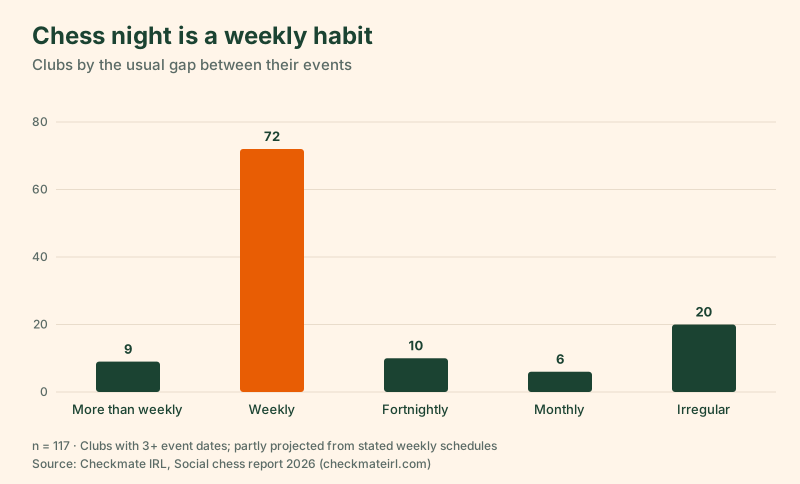
| How often | Clubs, all events | Share | Clubs, dated listings only | Share |
|---|---|---|---|---|
| More than weekly | 9 | 7% | 4 | 6% |
| Weekly | 72 | 61% | 30 | 50% |
| Fortnightly | 10 | 8% | 9 | 15% |
| Monthly | 6 | 5% | 1 | 1% |
| Irregular | 20 | 17% | 16 | 26% |
| All clubs measured | 117 | 60 |
A club's rhythm is the usual gap between its event dates: up to 4 days counts as more than weekly, 5 to 10 days as weekly, 11 to 20 as fortnightly and 21 to 45 as monthly. Some clubs barely miss a night: StrangerChess in Berlin had an event on every one of the 52 days from 1 September to 22 October.
Part of the weekly share is built in, because we project weekly nights from clubs' own stated schedules. Counting dated listings only, half of the 60 clubs we can measure meet weekly. Monthly clubs are undercounted, since few reach 3 dates in 8 weeks, and a club we miss some nights for looks less frequent than it is.
How long does a chess night last?
About 3 hours, and it usually wraps up around 22:00. Taking each club's usual listed length, the median club runs for 3 hours, and 109 of 125 clubs list 2 to 5 hours. 22:00 is the most common end time (37 clubs), and the median club finishes at 21:30.
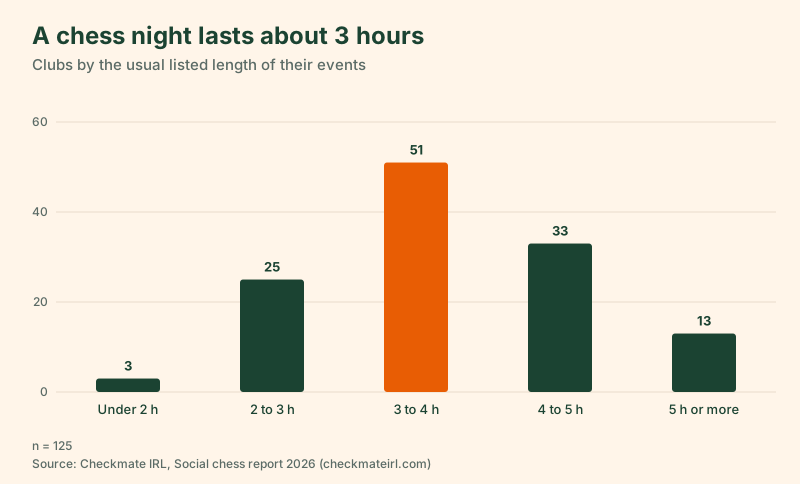
| Usual length | Clubs | Share of clubs |
|---|---|---|
| Under 2 hours | 3 | 2% |
| 2 to 3 hours | 25 | 20% |
| 3 to 4 hours | 51 | 40% |
| 4 to 5 hours | 33 | 26% |
| 5 hours or more | 13 | 10% |
These are listed end times, from 1,948 events that have one. Event tools often suggest a default length, which some organisers may leave as it is, and a listed end time says nothing about how long people stay.
Do chess clubs meet in bars or cafés?
In bars, nearly twice as often. Of the 225 venues social chess clubs use, 88 are bars (39%) and 46 are cafés (20%). 43% of the clubs we've linked to a venue (74 of 170) play in a bar at least some of the time, against 23% (40) in a café.
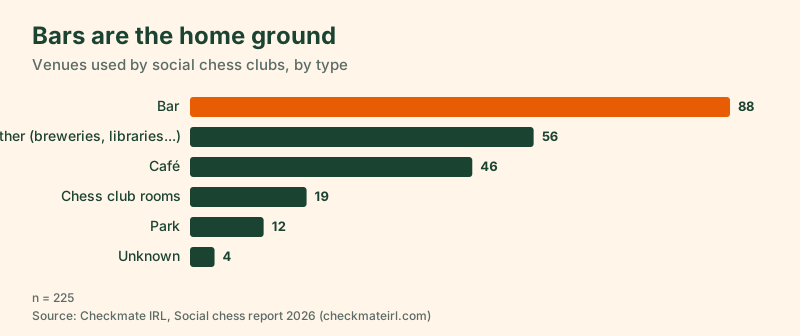
| Venue type | Venues used by clubs | Share of venues |
|---|---|---|
| Bar | 88 | 39% |
| Other (breweries, libraries, community centres, hotels and similar) | 56 | 24% |
| Café | 46 | 20% |
| Chess club rooms | 19 | 8% |
| Park | 12 | 5% |
| Unknown | 4 | 1% |
| All venues | 225 |
A few pubs and breweries sit under "other", so bars are, if anything, undercounted. That gap shows up although our map holds almost equal numbers of chess bars (355) and chess cafés (359).
Many clubs have no fixed home: 1 in 4 venue-linked clubs (41 of 170, 24%) use 2 or more venues, and 13 use 3 or more.
Our list of chess bars and cafés covers the places built around the game, and the guide to starting a chess club covers finding a venue for a new night.
Do UK and German clubs play in different places?
Yes. In the UK, social chess lives in the pub; in Germany, it leans toward cafés. 54% of UK clubs with a known venue play in a bar at least sometimes, against 43% in the US and 18% in Germany. In Germany, cafés lead instead: 9 of 22 clubs (40%) use one.
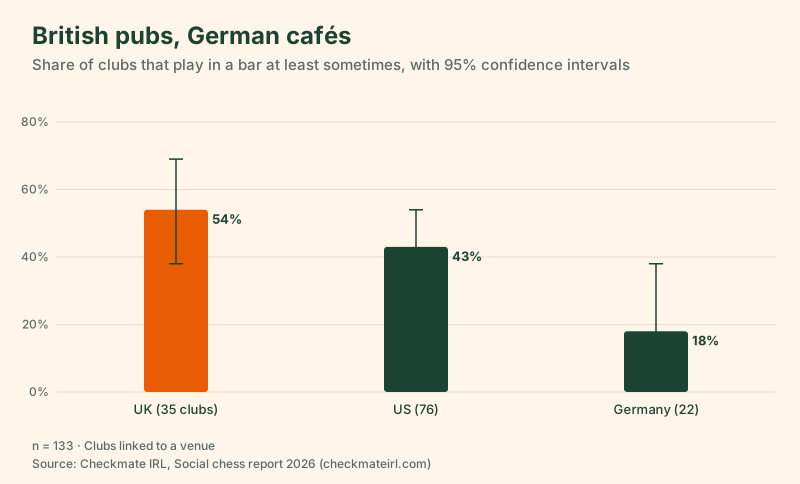
| Country | Clubs with a venue | Use a bar | 95% confidence interval | Use a café |
|---|---|---|---|---|
| United Kingdom | 35 | 19 (54%) | 38 to 69% | 4 (11%) |
| United States | 76 | 33 (43%) | 32 to 54% | 17 (22%) |
| Germany | 22 | 4 (18%) | 7 to 38% | 9 (40%) |
Germany's sample is small, so its range is wide. Even so, the UK and Germany gap is unlikely to be chance (p ≈ 0.012); the UK and US shares are too close to separate. German clubs also play in youth and community centres, which sit under "other".
This covers the 170 of 253 clubs we've linked to a venue so far; the other 83 often move around or don't publish an address, and the venue types are our own classification.
How do social chess clubs find players?
Mostly on Instagram. 71% of listed clubs (180 of 253) have an Instagram account, and for 47% (121) it's their only public channel. Own websites (18%), Meetup groups (14%) and Eventbrite pages (7%) trail well behind.
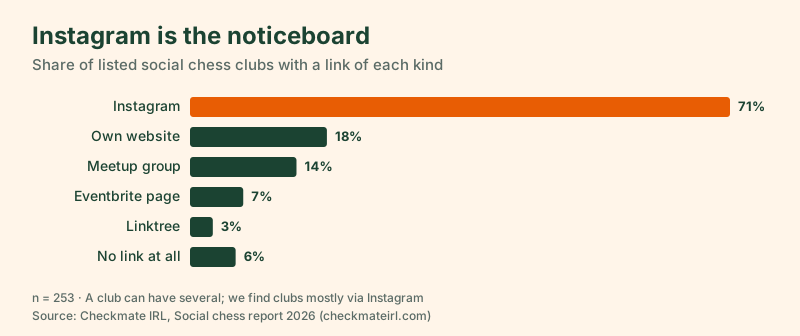
| Channel | Clubs | Share of clubs |
|---|---|---|
| 180 | 71% | |
| Instagram and nothing else | 121 | 47% |
| Own website | 48 | 18% |
| Meetup group | 37 | 14% |
| Eventbrite page | 19 | 7% |
| Linktree | 10 | 3% |
| No public link | 16 | 6% |
Instagram use is highest outside the 3 biggest countries (84% of clubs); among those 3, it's 75% in the US, 55% in the UK and 53% in Germany. Eventbrite only shows up in the UK (11 clubs) and the US (8), and own websites are most common in Germany (11 of 32), often a classic club or youth-centre site.
Our directory leans toward clubs with a public social media presence, which pushes this share up. If you run a club, the guide to starting a chess club covers getting the word out.
Beyond the clubs: where else can you play?
Clubs are one way in. Our venue map holds 4,600+ places to play chess in 100+ countries, and about 2 in 3 of them (3,067 of 4,628) are outdoor public boards and tables. Where opening hours are known for those, 96% are open 24/7, mostly per OpenStreetMap tags.
- Giant boards. We've mapped 1,500+ places with a giant walk-in board, and nearly 3 in 4 of them (1,146 of 1,570) are in Germany, which partly measures how thoroughly German volunteers tag them on OpenStreetMap.
- Bars and cafés. The map holds 355 chess bars and 359 chess cafés; the United States has the most of any country (169) and Berlin the most of any city (25).
- Casual events. In September 2026, London had 141 casual chess events in our feed from 50 different organisers, about twice the 68 in New York (both counted by local date, scheduled events only). Nantes came second on raw count with 74, all from one organiser.
Upcoming casual events are on our chess events pages, with city pages for London, Berlin and Munich. The map's mix reflects our outdoor-first sourcing, Germany as our home market and thorough OpenStreetMap coverage in Germany and Poland.
How sure can we be?
Sure enough on the main patterns, with wider margins on the details.
A chi-square test asks how likely a pattern this uneven would be if clubs picked their night at random. For our 143 clubs, the answer is less than 1 in 1,000 (χ² = 33.2 with 6 degrees of freedom, p < 0.001), so the weekday pattern is very unlikely to be chance.
A 95% confidence interval gives the range a share most likely falls in, allowing for the fact that 143 clubs is a small group. Wednesday comes to 25% (18 to 32%), Tuesday to 23% (16 to 30%) and Friday to 4% (2 to 9%); the full set is in the table under "Which night is chess night?". Tuesday and Wednesday together come to 48% (40 to 56%).
For start years, 141 of 205 dated clubs started in 2023 or later: 68%, with a 95% confidence interval of 62 to 74%. By country, it's 65% in the US (55 to 74%, 91 clubs), 84% in the UK (68 to 93%, 32 clubs) and 75% in Germany (53 to 88%, 20 clubs). The UK and German groups are small, so their intervals are wide, and no interval can correct for the fact that we only see clubs still running today.
An exact binomial test asks, for 2 nights, whether the split between them could be a coin toss.
- Wednesday against Friday. Of the 43 clubs meeting on either day, 36 pick Wednesday. That's a clear difference (p < 0.001).
- Wednesday against Tuesday. 36 against 33 is a statistical tie (p ≈ 0.8), so Tuesday and Wednesday share the title of chess night.
- Friday against Sunday. 7 against 12 could still be chance (p ≈ 0.36), so Friday is the quietest night we see, and we can't show it's quieter than Sunday.
For bars by country, a Fisher's exact test compares 2 shares in small groups.
- UK against Germany. 19 of 35 clubs against 4 of 22 is unlikely to be chance (p ≈ 0.012). The confidence intervals (38 to 69% and 7 to 38%) overlap slightly, because Germany has 22 clubs.
- US against Germany. 33 of 76 against 4 of 22 is a smaller gap and borderline (p ≈ 0.045); with 3 comparisons and 22 German clubs, treat it as a hint.
- UK against US. 54% against 43% could be chance (p ≈ 0.31).
By country, the median of each club's usual start time, in local time, sits close together:
| Country | Clubs | Median usual start | Clubs meeting at the weekend |
|---|---|---|---|
| United States | 68 | 18:00 | 15 |
| United Kingdom | 34 | 18:00 | 5 |
| Germany | 19 | 18:30 | 2 |
German clubs start half an hour later at the median and fewer of them meet at the weekend, but these groups are too small to call that a difference.
Sample sizes differ by finding, so here they are in one place:
- Weekday, start time and busiest slot: 143 clubs with events
- How often: 117 clubs with 3 or more event dates (60 on dated listings only)
- Length and end time: 125 clubs with listed end times
- Venues: 170 clubs linked to 225 venues
- Channels: all 253 listed clubs
- Start year: 205 of the 253 listed clubs we could date
These tests rest on 2 months of event data, from one feed that leans English-speaking, and on the clubs we happen to list. A confidence interval covers sampling noise only; it can't correct for which clubs are in our directory.
How we counted
- Snapshot. All figures come from Checkmate IRL's own databases, queried on 23 October 2026. This is version 2 of the report, which adds the club analysis and the charts.
- Social chess clubs directory. 253 listed clubs in 33 countries and 115 cities, found through public listings and club pages and reviewed before listing.
- Casual events. 2,385 events from 31 August 2026 onward in about 50 cities, collected from public event listings and club pages during September and October 2026. 1,297 are dated listings; the other 1,088 are weekly nights we project about 4 weeks ahead from a club's own stated schedule. Rated tournaments and online events are left out. 143 of the 253 clubs have events in the feed.
- Club night and start time. Each club counts once, by the weekday it uses most often, in local time. The start-time chart and the heatmap place each club in its single most common weekday-and-hour slot, which is why the heatmap shows 32 Tuesday and 37 Wednesday clubs against 33 and 36 in the weekday table.
- How often. For each club with 3 or more distinct event dates, we take the median gap between dates. A club counts as irregular when fewer than 60% of its gaps fall within a quarter of that median (at least 1 day).
- Length and end time. Each club's median listed length and end time, from the 1,948 events with an end time, after dropping 2 outliers.
- Venues. Venue links are our own records of where each club plays; venue types are our own classification on the map.
- Channels. A club counts for a channel when we hold a link of that kind for it.
- Start year. For each club, the earliest date we could find for its public online presence, from its own public pages and accounts, checked on 23 October 2026. 205 of 253 clubs could be dated.
- Venue map. 4,628 places to play in 104 countries and 1,488 cities, gathered from player and venue submissions, our own research and OpenStreetMap tags.
- Cities and organisers. Events are counted by their local date; organisers are distinct organisers in that month, counted by each listing's organiser key.
- Statistics. Shares come with Wilson 95% confidence intervals. The weekday pattern is tested with a chi-square goodness-of-fit test against an even spread, pairs of nights with an exact binomial test, and bar shares by country with Fisher's exact test.
- Rounding. Headline totals are rounded down (4,628 becomes 4,600+), and percentages and interval bounds are rounded down too, so a column can add up to a little under 100%.
- Charts. The 10 charts and the data behind them are free to reuse with a link to this page.
What the numbers don't show
- Growth in our own totals. Our counts rise when we run a sourcing sweep. Venue rows jumped by 1,427 in May 2026 and by 1,595 in August 2026, and both jumps were OpenStreetMap sweeps, mostly parks. The event feed starts on 31 August 2026, so there's no earlier history to compare against.
- Founding years. We don't know when clubs were truly founded, so we use the year of each club's earliest public page or account as a stand-in. The date a club entered our directory is our own batch history, and we don't use it.
- Attendance. We hold no figures for how many people come to a club night.
- Coverage. Our sources are strongest in English and in cities. Between 59% and 69% of listed clubs in the US, the UK and Germany have events in our feed, against 31% elsewhere.
- Completeness. Our listings are a sample of what organisers post, so event counts are a lower bound, and November onward is incomplete because organisers post late.
- Per-capita rates. We hold no population data.
- Prices. We hold no price data. "Free" for outdoor boards follows from what they are.
- App games. Games recorded in the Checkmate IRL app aren't included; the sample is too small to publish.
Using this data
The figures, tables, charts and the data file are licensed under CC BY 4.0: free to reuse, also commercially, with credit to Checkmate IRL and a link to this page. Journalists and bloggers are welcome to use the figures, tables and charts here, with a link to this page as the source. Every chart is downloadable as SVG from the link under it; please credit Checkmate IRL and link this page. A suggested credit: "Source: Checkmate IRL, Social Chess Clubs in 2026 data report (October 2026)." For a breakdown by city or country, contact us via the contact page and I'll run the same counts for that place.
Frequently asked questions
When did most social chess clubs start? In 2023 or later, going by the year each club's earliest public page or account was created. That covers 141 of the 205 clubs we could date, and the median year is 2024. A page date isn't a founding date, and a club can be older than its online presence.
Is social chess growing? The start dates fit a wave of new clubs since 2023: 141 of the 205 clubs we can date (68%) started in 2023 or later. We only see clubs that are still running, though, so clubs that started and stopped earlier are missing, and the data alone can't rule out a scene where clubs come and go quickly. Our article on the rise of social chess clubs covers the trend.
How many social chess clubs are there? Our directory lists 253 in 33 countries and 115 cities. The United States (102), the United Kingdom (49) and Germany (32) hold 72% of them, which partly reflects where our sources are strongest, so the number worldwide is unknown.
Which city has the most social chess clubs? London, with 31 listed clubs, ahead of New York (21), Los Angeles (14), Chicago (12) and Berlin (10). London also had the most casual chess events in our feed in September 2026 (141).
Which night is chess night? Tuesday and Wednesday, together. Nearly half of the 143 social chess clubs with events in our feed usually meet on one of those 2 nights, with Wednesday (36 clubs) narrowly ahead of Tuesday (33), a gap too small to be meaningful. Friday is the quietest night we see, with 4% of clubs, clearly below Tuesday and Wednesday.
What time do chess clubs start? Usually at 18:00 or 19:00 local time, which covers 62% of clubs, and only 7 of 143 start at 20:00 or later. Daytime clubs are mostly weekend clubs: 25 of the 34 that start before 17:00 meet on a Saturday or Sunday.
When is the busiest hour for social chess? Wednesday at 18:00, with 17 clubs and 227 events, the most of any hour in the week. Tuesday at 19:00 comes next with 15 clubs and has the most different organisers (30). Weekend chess happens around midday.
How often do social chess clubs meet? Weekly, for most. 61% of the 117 clubs we can measure meet once a week and 7% more often; on dated listings alone, it's half of 60 clubs. The median club held 4 nights in September 2026.
How long does a social chess night last? About 3 hours, by the median club's listed length, and 22:00 is the most common end time. These are listed times, and some may be defaults of the event tool an organiser uses.
Do chess clubs meet in bars or cafés? Bars, nearly twice as often: 88 of the 225 venues clubs use are bars and 46 are cafés. 43% of the 170 clubs with a known venue play in a bar at least some of the time, and 1 in 4 rotate between 2 or more venues.
Do UK and German chess clubs meet in different places? Yes. 54% of UK clubs with a known venue play in a bar at least sometimes, against 18% in Germany, where cafés lead at 40%. Germany's sample is small (22 clubs), but the gap is unlikely to be chance (p ≈ 0.012).
How do social chess clubs announce their nights? Mostly on Instagram: 71% of listed clubs have an account, and 47% have no other public channel. 18% have their own website, 14% a Meetup group and 7% an Eventbrite page. Our directory leans toward clubs with a public social media presence, which pushes this share up.
How many places to play chess are there? We've mapped 4,600+ in 100+ countries, about 2 in 3 of them outdoor boards. That's a catalogue that grows with each sourcing sweep, so the number of places in the world is unknown.
Can I use these charts and figures? Yes. Everything here is licensed under CC BY 4.0: every chart is downloadable as SVG, and the data file and tables are free to reuse, also commercially. Please credit Checkmate IRL and link this page. For a city or country breakdown, contact us via the contact page.
Download Checkmate IRL
Checkmate IRL is the companion app for over-the-board chess: a chess clock that saves your results, an offline rating, and a map of places to play near you.